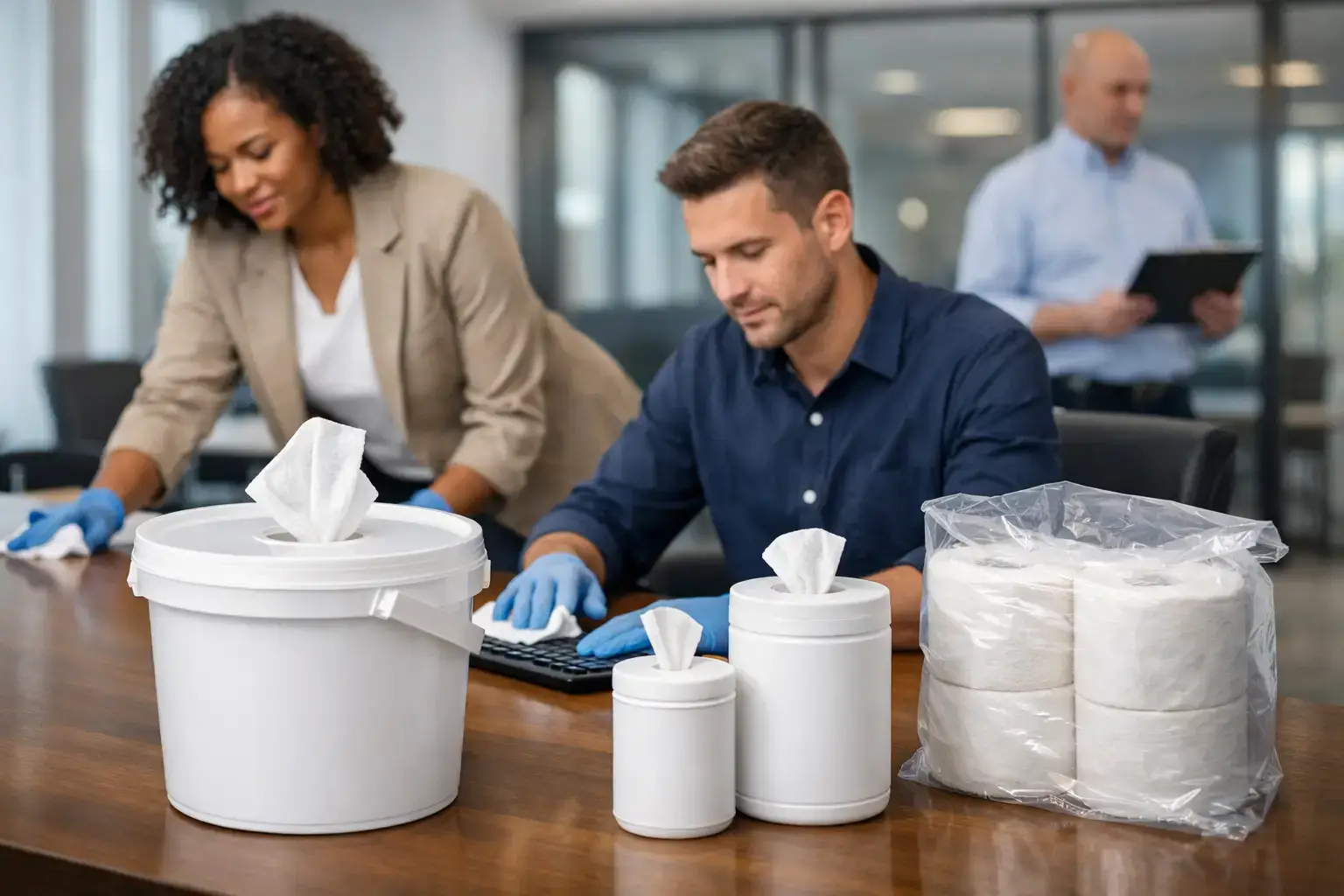
A missed cleaning step in a clinic exam room, a shared control panel on a production floor, or a high-touch checkpoint in a public building can turn into a compliance problem fast. That is why bulk disinfecting wipes for businesses are not just a convenience item. In many facilities, they are part of the daily control system for infection prevention, workplace safety, and operational continuity.
For procurement teams and facility leaders, wipes sit in a category that looks simple until it is not. The wrong product can create residue, damage surfaces, frustrate staff, or fail to align with disinfection protocols. The right product supports faster response, cleaner documentation, and better consistency across shifts.
Why bulk disinfecting wipes for businesses matter
In regulated and high-traffic environments, speed matters, but consistency matters more. Spray-and-cloth systems still have a place, especially for large surface areas and certain dwell-time requirements. But wipes solve a different problem. They provide a controlled amount of chemistry, reduce setup time, and make spot disinfection easier to standardize.
That matters in healthcare spaces, aviation settings, manufacturing facilities, government buildings, and commercial operations where staff are moving quickly between tasks. A pre-saturated wipe reduces guesswork. Teams are less likely to under-apply solution or grab the wrong dilution. When the product is selected well, the result is a cleaner process that is easier to train, easier to monitor, and easier to repeat.
There is also a practical inventory advantage. Bulk formats support distributed cleaning programs. Instead of storing small retail packs in scattered closets, operations teams can stock by case, assign by zone, and maintain a steadier replenishment cycle. That lowers the risk of empty stations during a shift or substitutions that do not meet facility requirements.
What buyers should evaluate before ordering in bulk
The first question is not wipe count. It is fit for use. Different facilities need different performance profiles, and the strongest-looking option is not always the best operational choice.
Surface compatibility comes first
A disinfecting wipe has to work on the surfaces your staff actually clean all day. That includes stainless steel, sealed hard surfaces, touchscreens, plastic housings, counters, handrails, and shared equipment. If a wipe leaves haze, dries too slowly, or risks damaging sensitive materials, staff will work around it. Once that happens, compliance starts to drift.
This is especially relevant in healthcare and manufacturing environments where equipment surfaces are both expensive and frequently touched. A product that performs well in a general office may not be appropriate near specialized devices, production controls, or surfaces with stricter maintenance standards.
Dwell time affects real-world use
Every disinfectant has a required contact time. On paper, a longer dwell time may still meet standards. On the floor, it can become a problem if teams wipe the surface dry too soon or move on before the chemistry has done its job. Shorter contact times can improve execution in busy settings, but they are not automatically better if they come with surface limitations or stronger chemical exposure.
Buyers should think about how staff actually clean. A realistic protocol beats a perfect one that nobody follows under pressure.
Chemistry should support safety and performance
Some facilities still assume stronger odor means stronger performance. That is not a sound purchasing standard. Modern institutional products can balance effective disinfection with more responsible chemistry, helping reduce unnecessary harshness without lowering expectations for sanitation outcomes.
That balance matters for indoor air quality, employee comfort, and repeated use across occupied spaces. In schools, offices, government buildings, and mixed-use facilities, a wipe that supports safer day-to-day use can improve adoption and reduce complaints. In higher-compliance environments, the chemistry still has to align with the facility’s protocols and documentation requirements.
Packaging and dispensing affect labor
A wipe is only useful if staff can access it quickly and the material stays usable through the life of the container. Poor dispensing leads to waste, torn wipes, and open lids that dry out the remaining product. Those seem like small issues until they scale across departments and shifts.
Bulk purchasing should account for how wipes are stored, issued, and used. Canisters may work well for fixed stations. Larger refill systems may fit central supply rooms. The best choice depends on whether your teams clean from carts, wall stations, maintenance rooms, or mobile kits.
Compliance is not optional
For serious facilities, buying disinfecting wipes is partly a documentation decision. Product performance matters, but so does the paper trail behind it.
Teams responsible for healthcare, government, industrial, and public-facing facilities often need supporting records such as SDS sheets, technical specifications, and relevant regulatory information. Procurement officers may also need consistency across sites so approved products match internal protocols and audit expectations.
This is where many low-friction consumer options fall short. A retail-friendly label does not tell you enough about institutional suitability. Buyers should be able to confirm claims, review handling guidance, and understand where a product fits within the facility’s sanitation program.
For contract-driven and government purchasing environments, vendor readiness also matters. Reliable fulfillment, product documentation, and a supplier that understands structured purchasing requirements can save time well beyond the initial order.
Where bulk wipes work best and where they do not
Bulk disinfecting wipes for businesses are highly effective for high-touch points and fast-turn cleaning tasks. They are a strong fit for door hardware, desks, counters, shared electronics housings, armrests, breakroom surfaces, restrooms, waiting areas, and common production touchpoints.
They are also useful for response cleaning when spills or contamination concerns require immediate action without setting up a full bucket or spray system. In facilities that operate across multiple shifts, wipes can improve handoff discipline because staff can complete quick disinfection steps without searching for additional tools.
But wipes are not the answer for every application. Large floor areas, heavily soiled surfaces, and tasks requiring deep soil removal often call for other systems. If organic load is high, staff may need a separate pre-cleaning step before disinfection. If the surface area is too large, wipes can become inefficient and increase material waste.
That is why the best programs treat wipes as one part of a broader cleaning strategy, not as a universal replacement for sprays, dilution systems, or task-specific sanitation methods.
How to build a better wipe program
A good product choice helps, but program discipline is what protects outcomes. Facilities that get the most value from wipes usually standardize their use in a few key ways.
They define where wipes belong and where they do not. They train teams on contact time, one-way wiping practices when applicable, and when to discard a wipe rather than stretch it too far. They also align ordering with actual consumption patterns by department instead of guessing from total building headcount.
It also helps to track wipe use against risk areas. A manufacturing plant may need different stocking levels at control stations than in administrative offices. A healthcare operation may place more emphasis on exam room turnover and high-touch patient-facing surfaces. A government facility may focus on public counters, security touchpoints, and shared work areas. The product can be the same, but the deployment strategy should reflect the environment.
Choosing a supplier, not just a product
In institutional purchasing, the product matters and the supplier matters almost as much. If your operation has compliance expectations, audit exposure, or multi-site demand, you need a source that understands documentation, fulfillment discipline, and facility realities.
That is especially true when buyers are trying to align environmentally responsible chemistry with institutional performance. There is no benefit in choosing a product that looks greener on paper if it cannot meet operational standards. At the same time, there is no reason to default to unnecessarily harsh formulations if safer chemistry can do the job within the required use case.
Veteran Commercial Cleaning operates with that balance in mind, serving buyers who need serious sanitation support without casual guesswork. For procurement officers, EVS leaders, and facility managers, that kind of discipline is often what separates a smooth rollout from a recurring supply problem.
The smartest wipe purchase is rarely the one with the biggest case count or the most aggressive label language. It is the one your teams will use correctly, your surfaces can tolerate, and your documentation can support when someone asks for proof.