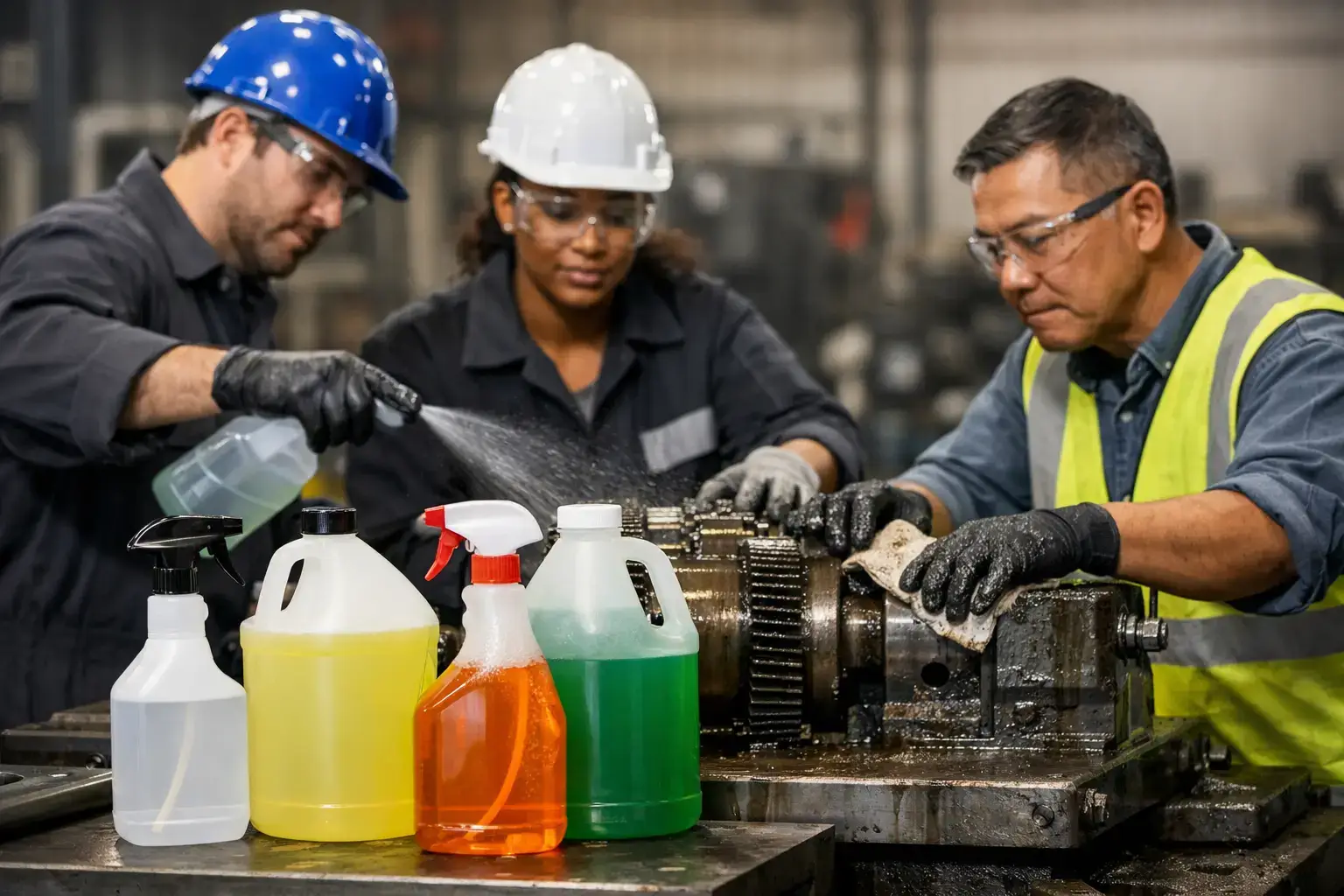
When a conveyor drive is coated in baked-on lubricant or a hydraulic housing is pulling in dust through oily residue, the wrong cleaner does more than slow down a task. It can create safety issues, damage finishes, complicate compliance, and leave equipment only partially clean. That is why selecting the top degreasers for industrial equipment is not simply a maintenance choice. It is an operational decision tied to uptime, worker safety, and documentation.
In high-compliance environments, buyers do not have the luxury of choosing by label claims alone. The right degreaser depends on the soil you are removing, the substrate you are protecting, the rinse conditions on site, and the standards your facility must meet. A maintenance team in manufacturing may need aggressive oil-cutting performance on steel assemblies. A healthcare or government facility may need lower-odor chemistry with stronger worker-safety alignment and clear technical documentation. The best product is the one that matches the work, the surface, and the risk profile.
What separates the top degreasers for industrial equipment
A true industrial degreaser should do more than break apart visible grease. It should lift petroleum soils, machining fluids, carbon residue, and shop grime without creating unnecessary hazards for operators or sensitive components. Performance matters, but so do material compatibility, VOC considerations, rinse behavior, residue profile, and SDS availability.
This is where many purchasing decisions go off track. Some teams assume stronger chemistry always means better results. In practice, overly harsh formulas can attack paint, haze plastics, stress rubber seals, or create ventilation concerns that increase procedural burden. On the other hand, a mild cleaner that is selected without regard to the soil load may require repeat applications and more labor, which also raises operational cost and downtime.
Top-performing degreasers usually fall into a few practical categories. Water-based alkaline degreasers are common because they cut many oils and greases effectively while supporting safer handling in many settings. Solvent-based products still have a place, especially where heavy petroleum buildup or low-moisture cleaning is required, but they demand tighter controls. There are also specialized eco-conscious formulations designed to balance institutional cleaning performance with reduced harshness, which is increasingly relevant for facilities that prioritize safer chemistry without lowering standards.
Start with the soil, not the brand
The fastest way to narrow the field is to identify exactly what is on the equipment. Light machine oil, oxidized grease, food-processing residue, carbonized deposits, and mixed industrial soils do not respond the same way.
For fresh oil and general shop grime, a water-based degreaser with surfactants and moderate alkalinity is often the most efficient option. It can be sprayed, brushed, or used in parts-washing systems, and it usually supports easier rinsing. For thick, aged grease in mechanical assemblies, stronger alkaline chemistry or a targeted solvent may be necessary. Where heat has polymerized the residue onto metal surfaces, dwell time and agitation often matter as much as the formula itself.
Facilities should also distinguish between open-surface cleaning and precision cleaning. Removing grease from a steel exterior panel is different from cleaning around motors, bearings, electrical housings, or coated control surfaces. In those cases, residue, conductivity, and drying characteristics move higher on the decision list.
Surface compatibility is where costly mistakes happen
The top degreasers for industrial equipment are not automatically safe for every substrate in the same facility. Industrial sites rarely contain only bare steel. You may be cleaning anodized aluminum, powder-coated panels, painted guards, polycarbonate shields, rubber gaskets, composite housings, or stainless assemblies in the same maintenance cycle.
High-pH degreasers can be highly effective, but they may discolor soft metals or dull certain finishes if used incorrectly. Solvents can swell elastomers, damage adhesives, or cloud plastics. Even products marketed as heavy-duty should be evaluated against real site conditions. A controlled compatibility test on a small, inconspicuous area is not a formality. It is basic risk management.
This matters even more in aviation, healthcare support spaces, and government facilities, where equipment value and service continuity leave very little room for avoidable damage. Cleaning chemistry should support equipment care, not trade one problem for another.
Compliance, documentation, and worker safety are part of performance
Industrial buyers are often measured on more than cleaning results. They are also accountable for safe chemical handling, training, storage, and documentation. That is why the strongest degreaser on paper may not be the strongest procurement choice.
A product should come with clear SDS documentation, technical specifications, and handling guidance that align with your facility protocols. If the cleaning program involves regulated environments or federal procurement, documentation quality becomes even more important. Environmental claims should also be credible and specific, not vague. Responsible chemistry can be a real advantage when it reduces exposure concerns, supports indoor air quality goals, and helps standardize safer use across teams.
For many facilities, especially those operating around staff, patients, travelers, or government personnel, lower odor and lower harshness are practical benefits. They can reduce disruption, simplify PPE planning in some applications, and make routine cleaning easier to execute consistently. That does not mean every task can be handled with the mildest formula available. It means the product should be matched to the task with discipline.
The main degreaser types and when they fit best
Water-based alkaline degreasers are often the best first-line option for routine industrial maintenance. They perform well on grease, oils, and dirt, especially when paired with dwell time and mechanical action. They are commonly used on manufacturing equipment exteriors, shop floors around machinery, tools, and washable components. Their biggest advantage is balance. They can deliver strong cleaning while supporting easier handling than many solvent-heavy alternatives.
Solvent-based degreasers are better suited to heavy petroleum soils, tar-like residue, and applications where low water exposure is preferred. They can be effective in maintenance environments dealing with stubborn buildup, but they also require close attention to ventilation, flammability profile, and material compatibility. They are not the automatic choice for every hard job, particularly in occupied or high-compliance spaces.
Citrus-based and other environmentally responsible degreasers can be useful when teams want better safety alignment without sacrificing practical cleaning power. Their effectiveness depends heavily on formulation. Some perform very well on grease and adhesive residue, while others are better positioned for lighter-duty maintenance. Buyers should assess actual industrial performance data rather than assume all green-labeled products behave the same.
Foaming degreasers can add value on vertical surfaces or complex equipment geometries because they cling longer and improve contact time. That can reduce runoff and help crews clean guards, housings, and external machine surfaces more thoroughly. The trade-off is that foam is not always ideal for enclosed assemblies or areas where rinse control is limited.
How to evaluate top degreasers for industrial equipment in the field
A paper review is only the first step. The better approach is a controlled field test against your actual soil conditions. Choose two or three candidate products, define the surfaces involved, and compare them on the same type of residue. Measure not just visible cleanliness, but also dwell time, need for agitation, residue after rinsing, odor impact, and any effect on nearby materials.
Labor should be part of the evaluation. A degreaser that removes oil in one pass may be operationally superior to a gentler product that requires repeat treatment, even if both eventually reach the same visual result. At the same time, if the more aggressive option creates added PPE burdens, corrosion concerns, or special disposal issues, the balance may shift.
Standardization matters as well. Many facilities end up with too many overlapping products because each department solves problems independently. A tighter product lineup, backed by clear use cases and technical documentation, usually improves training, storage control, and ordering efficiency.
For procurement teams, supplier reliability is part of the equation. Products used in critical environments should be supported by dependable fulfillment, documentation readiness, and category expertise. Veteran Commercial Cleaning serves buyers who need that level of structure, particularly in institutional and government-facing settings where compliance and consistency are not optional.
Common buying mistakes to avoid
One common mistake is selecting for maximum strength without defining the actual contaminant. Another is assuming a degreaser that performs well on floors or tools will be appropriate for sensitive equipment surfaces. Teams also underestimate the cost of residue, especially in settings where leftover film attracts dust, interferes with inspections, or complicates follow-up sanitation.
There is also a tendency to treat environmental responsibility and industrial performance as opposing goals. In many facilities, that is an outdated assumption. Modern formulations can support both safer handling priorities and strong cleaning outcomes, provided the product is selected with discipline and tested under real conditions.
The best degreaser program is rarely the most aggressive one. It is the one that cleans effectively, protects equipment, supports worker safety, and stands up to operational scrutiny when auditors, supervisors, or contracting officers ask for the paperwork.
A smart purchasing decision starts with a simple question: what exactly does this equipment need cleaned off, and what can the surface, workforce, and facility protocol safely support? Answer that well, and the right degreaser usually becomes clear.