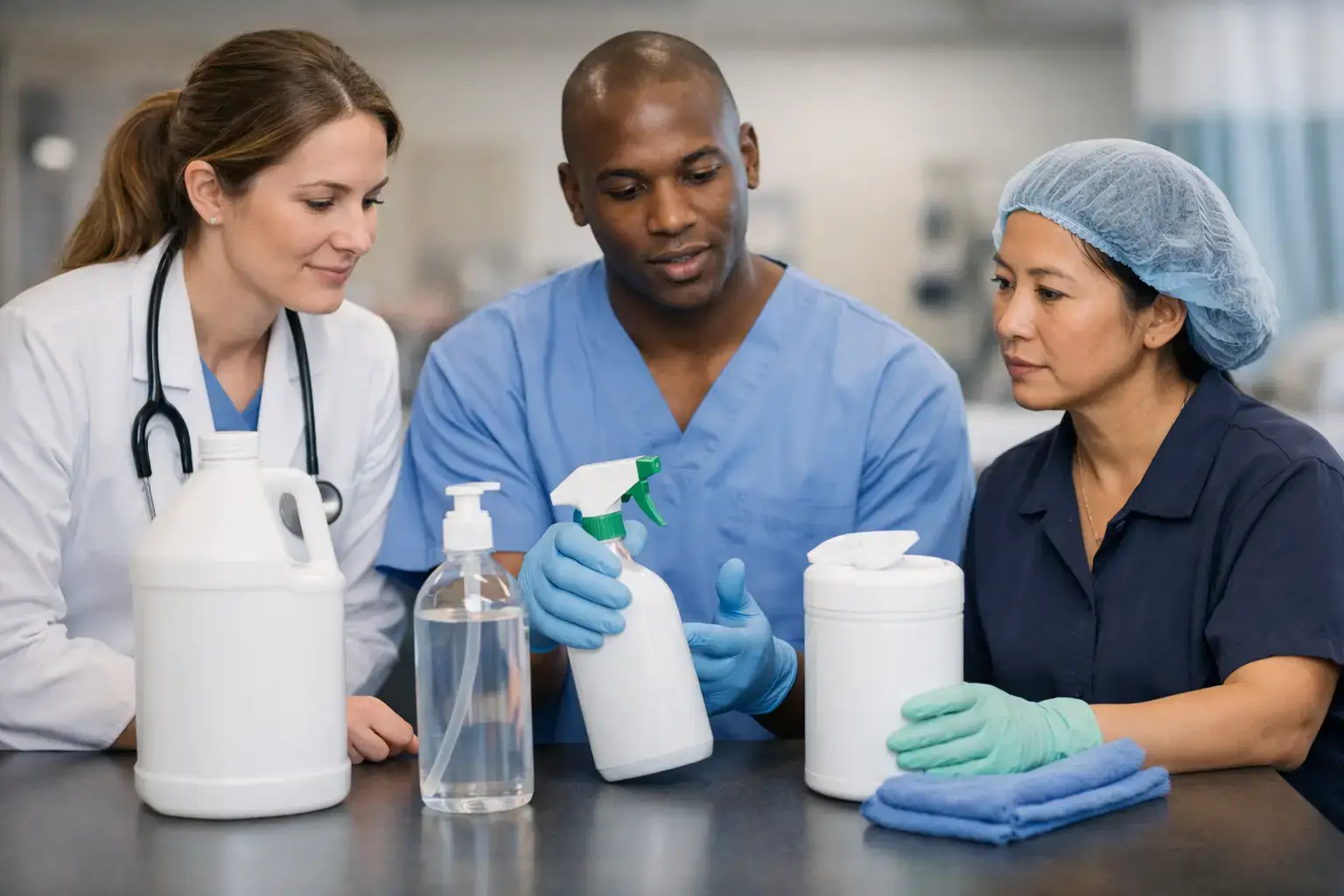
A disinfectant that works well in one clinical area can create problems in another. The product used on an emergency department stretcher may not be the right fit for a neonatal unit, surgical suite, or waiting room touchpoint. That is why knowing how to choose hospital disinfectants is less about finding the strongest chemistry and more about matching efficacy, safety, surface compatibility, and compliance requirements to the real conditions inside your facility.
Healthcare buyers and environmental services leaders are rarely choosing for a single room or a single pathogen. They are choosing for workflows, staff consistency, documentation demands, and the risk tolerance of a regulated environment. A product that kills quickly but requires difficult handling may underperform in practice. A product with a broad efficacy claim but poor material compatibility can increase equipment damage and replacement costs over time.
How to Choose Hospital Disinfectants by Risk Profile
The most reliable starting point is the risk profile of the environment. Not every space in a hospital carries the same exposure level, and disinfectant selection should reflect that reality. High-touch, high-turnover, and high-acuity areas need faster, broader, and easier-to-execute disinfection protocols than low-risk administrative spaces.
Patient rooms, emergency departments, operating areas, isolation rooms, and transport equipment all create different performance demands. In one setting, short contact time may matter most because staff need rapid room turnover. In another, compatibility with sensitive equipment may carry more weight. For areas serving immunocompromised patients, the margin for error is smaller, which means the product choice has to support both microbial efficacy and consistent staff use.
This is where many purchasing decisions fail. Teams compare labels but do not compare use conditions. If the product instructions are too complex for the pace of care, actual disinfection performance may fall short even when the chemistry is sound.
Start With the Required Efficacy Claims
A hospital disinfectant should be evaluated first by what it is registered and validated to do. Buyers need to confirm that the product carries the appropriate efficacy claims for the organisms and categories relevant to their setting. That includes reviewing whether it is intended for hospital use, whether it meets the facility’s pathogen concerns, and whether it aligns with internal infection prevention protocols.
Broad-spectrum performance matters, but broader is not automatically better if it comes with trade-offs that affect usability or safety. Some facilities need a disinfectant that supports routine daily disinfection across general patient care areas. Others need products tailored for outbreak response, isolation procedures, or specific contamination scenarios. The right choice depends on the clinical and operational role of the product.
Documentation matters here. Procurement teams and infection prevention leaders should expect complete technical specifications, SDS documentation, and clear use instructions. In regulated environments, unsupported claims create unnecessary exposure.
Contact Time Is a Real-World Performance Issue
One of the most overlooked factors in hospital disinfectant selection is contact time. A product may test well in controlled conditions, but if it requires a wet dwell time that staff cannot realistically maintain during room turnover, compliance suffers.
Shorter contact times can improve execution in fast-moving environments, especially in emergency care, outpatient treatment areas, and shared equipment workflows. That said, speed should not be the only decision factor. A slightly longer contact time may still be acceptable if the product offers better compatibility, lower residue, or safer handling.
The key question is practical: can your team use this product correctly, every shift, under normal workload conditions? If the answer is uncertain, the strongest efficacy profile on paper may not translate into dependable results.
Evaluate Surface and Equipment Compatibility
Hospitals contain a wide range of materials, from stainless steel and hard nonporous surfaces to plastics, screens, touch panels, coated metals, vinyl, and specialized medical equipment housings. Disinfectants that are too aggressive can shorten the life of these materials, create cosmetic damage, or interfere with device function.
Compatibility should be reviewed early, not after implementation problems appear. This is especially important for facilities managing high-value assets such as imaging equipment, monitors, transport devices, or specialty treatment chairs. Repeated exposure to certain chemistries can cause cracking, clouding, corrosion, or residue buildup that affects both appearance and operation.
There is no universal chemistry that is ideal for every surface. The best procurement decisions balance pathogen kill claims with the physical realities of the environment. If a product damages commonly used surfaces, teams may begin avoiding it, diluting it incorrectly, or using unauthorized substitutes.
Staff Safety and Indoor Exposure Matter
Hospital disinfectants must support infection prevention without creating avoidable occupational hazards. Environmental services teams, nursing staff, and clinical support personnel may use these products repeatedly throughout the day. If the chemistry causes strong irritation, difficult ventilation concerns, or complex PPE burdens beyond the task, the likelihood of inconsistent use rises.
This is where product selection becomes more than a technical exercise. It becomes a workforce and implementation issue. Safer chemistry can support stronger compliance if it reduces barriers to proper use while still meeting hospital-grade disinfection standards.
That does not mean selecting the mildest product available. It means choosing a formulation appropriate for the task, the room conditions, and the staff who will use it. In many facilities, environmentally responsible chemistry is no longer treated as a preference alone. It is part of broader goals around workplace safety, air quality, and responsible procurement.
Consider Format, Workflow, and Training Burden
When teams discuss how to choose hospital disinfectants, they often focus heavily on chemistry and underweight delivery format. But format affects everything from training time to dosing accuracy to cross-department adoption.
Ready-to-use products can reduce dilution error and improve consistency, particularly in decentralized use across nursing units and shared clinical areas. Concentrates may make sense where trained staff, controlled dispensing, and larger-scale environmental services workflows are in place. Wipes can improve convenience for equipment and high-touch surfaces, but buyers still need to verify saturation, compatibility, and contact time requirements.
A good disinfectant on the wrong delivery system can create unnecessary variation. If your team needs separate instructions for every area, every shift, and every user group, complexity becomes the enemy of compliance. The easier the protocol is to understand and repeat, the stronger your actual performance will be.
Standardization Has Limits
Standardization can simplify training, purchasing, and inventory control, but hospitals should be careful not to force one product into every scenario. A facility may benefit from a core disinfectant for general use and a smaller number of specialized products for higher-risk applications or sensitive equipment.
That balanced approach often produces better compliance than either extreme. Too many products create confusion. Too few can create performance gaps.
Verify Compliance Support Before You Buy
Hospitals and healthcare contractors need more than a label. They need documentation that supports audits, safety programs, training files, and procurement review. A serious supplier should be able to provide SDS sheets, technical data, regulatory details, and use guidance without delay.
This is particularly important for government healthcare environments, military treatment settings, and large institutional systems where purchasing reviews are not handled informally. In those settings, vendor readiness matters almost as much as product performance. If documentation is incomplete or inconsistent, the burden shifts to your internal team.
Buyers should also look at how clearly the product is positioned for healthcare use. Ambiguous labeling or consumer-style marketing language is a poor fit for clinical procurement. Hospital environments require clear instructions, defensible claims, and reliable specification support.
Trial the Product Under Real Conditions
Before full rollout, test the disinfectant where it will actually be used. That means evaluating it during live workflows, with the staff and surfaces that define day-to-day operations. A conference room review is not enough.
During a trial, teams should pay attention to whether the product leaves residue, whether staff can maintain the contact time, whether surfaces tolerate repeated use, and whether training requirements are reasonable. If environmental services and clinical users respond differently to the same product, that signals a workflow issue that needs to be addressed before standardization.
This trial phase also helps separate preference from performance. Some complaints are superficial. Others point to real barriers that will affect compliance over time.
The Best Choice Is the One Your Facility Can Sustain
The right hospital disinfectant is not simply the one with the most aggressive kill profile or the longest list of claims. It is the one that fits your risk profile, supports correct use, protects staff, aligns with your materials, and stands up to documentation review.
For healthcare facilities, government buyers, and high-compliance operators evaluating suppliers across the United States, that usually means choosing products backed by clear technical support and practical implementation discipline. Veteran Commercial Cleaning approaches disinfectant selection with that same standard – performance you can document, chemistry you can use responsibly, and procurement support that holds up in critical environments.
If your current disinfectant program looks good only on paper, it may be time to reassess what staff can actually execute under pressure. That is where better outcomes usually begin.